





Kaikoura Concrete Supply – Case Study
From the Archives: Originally presented at the 2018 Concrete NZ Conference, this case study looks back at Allied Concrete’s role in supplying concrete for the Kaikōura earthquake recovery and the reopening of SH1. We’re sharing it again as part of celebrating the projects that have helped shape our 50-year history.
Summary
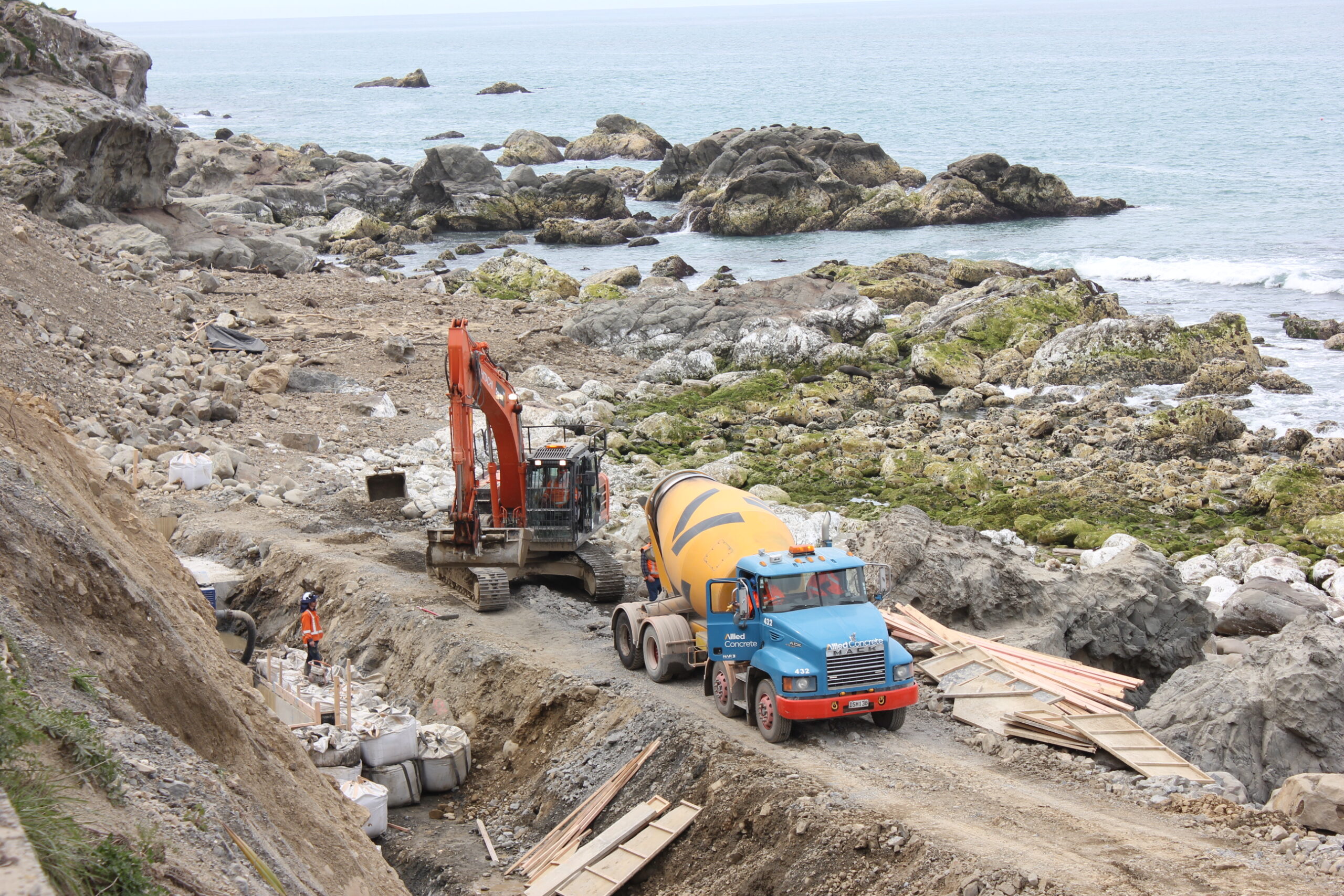
Allied Concrete’s contribution to the re-opening of SH1 in Kaikoura involved the manufacture and transport of some 90,000m3 of concrete and cement stabilised materials largely delivered over a 3.5-month timeframe from September 2017 to December 2017.
This was achieved by establishing 1 concrete plant, 3 pugmills and supporting infrastructure for production of aggregates and cement delivery and storage that, at times were working 24 hours per day, 6 days per week.
Safety was built into the plant facilities and logistics by the identification of key controls up-front and the use of behavioural coaching programmes that ultimately resulted in nil LTI’s. This was despite the high pressure operating environment and objective risks that existed.
Ultimately, the project is an example of what construction and supply teams can achieve when alignment on purpose occurs. Design and construction occurred virtually simultaneously without compromise to quality.
Background – The Project
Allied Concrete was approached to assist in the North Canterbury Transport Infrastructure Recovery (NCTIR), which was set up by the government late December 2016 to restore the earthquake damaged infrastructure between Picton and Christchurch.
The plant was one of several operations procured along the route to service the repair zones. Our initial brief was to deliver some 10,000m3 of concrete over a 40-week period.
During the May-July 2017 period, an enormous amount of work was being done by the NCTIR design teams on concept studies that were ultimately presented to the supply chain in August 2017.
The most challenging stretch of road is located between Hapuku and the Clarence River, north of Kaikoura where the likelihood of continued slips on the faces after clearing was to be solved by pushing the road alignment towards the sea and further away from the coastal slopes.
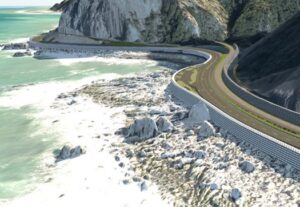
Artist impression courtesy of NCTIR of the completed seawall. This shows the general arrangement with foundation concrete underlying the concrete block walls with nofines concrete and cement stabilised fill forming the backfill behind the wall.
This involved the construction of a large retaining wall on the newly uplifted land. 30 MPa
concrete was required for the mass foundation footings; 50 MPa concrete for the precast
seawall blocks. Backfill behind the retaining wall required a nominal 2MPa no-fines concrete
that was capped off by 4% cement stabilised 65.
The size of the task was enormous with 3 key retaining structures to be constructed. These had the non-descript names of Wall 2 (between Hapuku and Nins Bin); Wall 6 (south of Ohau Point) and Wall 7 (around and to the north of Ohau Point). This was nearly 2 km of wall and roading up to 9m high.
By late July the construction methods were ironed out and in early August the conversations turned to how much ourselves and others in the region were able to do.
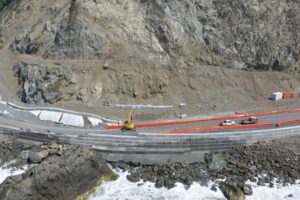
The reality behind the artist impression. This shows the partially completed and backfilled retaining wall during construction. Photo courtesy of NZTA gallery.
The Allied Team Response
We very quickly established that the scale of the job meant that a team approach was required. With our aggregate and cement partners, Fulton Hogan and Holcim Cement the key challenges quickly crystallised.
These were identified as crushing and screening enough materials; storage capacity; the cement tanker fleet to service the operations via the inland route to Kaikoura and getting enough people on the ground at a time when national concrete outputs were already at historical highs.
We established our project purpose for on-boarding new members to the team quickly. Although a simple step, it galvanised with different parent organisations quickly around prioritising actions, providing the why for people involved in the project.
Working out why we were in Kaikoura was not too difficult (Figure 4). The induction made our purpose clear.
Collectively, efforts were made to:
- Get a trial undertaken down in Christchurch on the no-fines concrete production
- Mobilise 250+t of cement storage capacity for the area
- Mobilise for no-fines production of up to 500m3/day
- Fit out cement trucks and train drivers for cement cartage at rates of up to 200t/day
- Gear up aggregate production in the Hapuku river to supply aggregates
- Gear up for concrete pours of up to 300m3/day into the mass foundations for the seawall
This ultimately took little over a month to achieve.
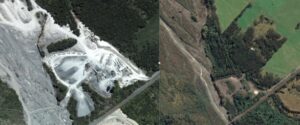
Development of the Hapuku river site (Figure 5) involved considerable earthworks to provide safe traffic networks that separated people from heavy plant and truck movements as this after and before shot shows. This key area of risk was factored in when the area was developed by the teams.
Design Development
One of the main challenges for the Client was the close time proximity between design and construction. Survey information in this environment is a huge undertaking and as a result of the site geometry, quantities did change.
This put programme pressures on and it quickly became apparent that more production capacity was required. In response to this, we mobilised two more pugmills that were located on the Rakautra site and on the Clarence.
Servicing of aggregates for the Rakautra was a mixture of the Hapuku river and the Kowhai in Kaikoura whilst a crushing and screening operation on the Clarence serviced the Clarence pugmill.
This saw a second phase of mobilisation that resulted in:
- Additional storage of cement capacity to 450t in the area
- Additional cement tanker mobilisation to take up to 450t/day into the area
- Resources into the Clarence and Hapuku rivers to increase screening/crushing capacity
This phase was largely finished by the end of September 2017. The project team’s attention then turned to how to maintain production on a consistent basis.
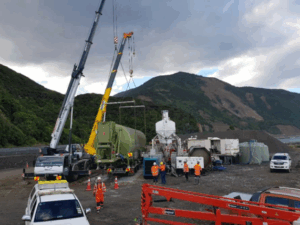
Mobilisation of additional storage to Nins Bin. This was the single biggest transported load during the emergency phase and conducted with high professionalism by Smith Cranes and NCTIR to facilitate the load to the works.
Production – Sprint and Stop, Sprint, Repeat
Production conditions were not business as usual for the construction teams. The main contributing factors outside of the project’s control were:
- The unstable nature of the slope faces. Rainfall resulted in further movement of the faces cutting off access to the key walls and inability to access the work areas. The figure below shows the impact of weather during a critical period
- The foundations for the retaining walls were in the zone of influence from high tides and wave action. This necessitated driver’s working shifts around tide and weather times. Data gathered during this period showed a 10% of August and September found wave heights higher than 2.0m. Whilst not classified as extreme, this was enough to cause problems for the foundation and concrete delivery crews working effectively at or below sea level
- Steep access to the wall foundations required skilful driving and often choked access
- The compressed programme resulted in just in time programming. This was unavoidable and challenged the site supervisory teams with all materials coming through single access points. Any delays to the prior activity knocked on the next trade
Rainfall over the critical months mid-September to mid-October had a large influence on early production as it resulted in further landslips on the working faces. Large dumps of rain were the main challenge. October was a historically wet month.
There were factors inside our control that also resulted in learnings.
- Running transport and plant at high utilisations day in and day out brought maintenance challenges with downtime. Sunday became a dedicated maintenance day
- Maintaining consistency of materials and the impact of material consistency on production was high. Stray boulders and wet materials due to the juxtaposition of winning and using influenced productivity
- Manpower to cover the NCTIR shift patterns was challenging. NCTIR adopted a weekend off every second weekend and had multiple teams to maintain this. The wider team had to adapt to this whilst often running 24-hour shifts
- Dayshifts on average were around 50-60% as productive as nightshifts due to the traffic limitations. This is not normally the case on construction projects
- Management of traffic flows became a key consideration to maintain productivity
- We could optimise load sizes above road limits as site was classified as a construction site and not a highway
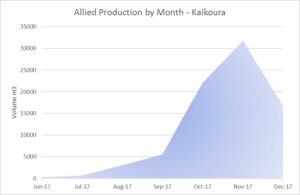
Graph showing production by month. To put this in perspective the Stats NZ production for the quarter ending Dec 17 for the Wellington region was 52,000m3 versus the 70,000m3 of products pushed out by the team in Kaikoura for the same period.
Production peaked in November 17 at just under 32,000m3 for the month of all concrete and cement stabilised products.
Building safety into the project and safety building
The large-scale challenges were recognised early and management systems put in place. Being a safe supplier was very important to our Client. The main challenges and measures put in place being:
- The unique nature of the driving environment. Long reversals at night and around large steep batters meant that a key management tool was behavioural coaching of the drivers. This was achieved using dedicated driver trainers who coached the site teams and signed off on competence in this particular driving environment
- Segregation of people and large numbers of truck movements at our plant locations. Movements of up to 200 vehicles per day were experienced in and around the Hapuku site. This was achieved by incorporating safety in design thinking to the initial site layout
- High pressure cement shifting was mitigated by the employment of uniquely qualified personnel from the recently decommissioned Westport Cement works
Dust control around the Hapuku site was also critical to wellbeing and the environment. To mitigate this, a scaffold structure was erected around the pugmill operation to control this.
We did have 1 MTI on the project as a result of a scald burn to the hand. We had nil LTI’s.
Fatigue was a challenge and whilst we found it relatively easily managed with the drivers; Supervisors of the various facilities bore the brunt of the shift work. There were no easy answers here.
Quality Standards
Concrete in the project was produced to NZS 3104 Standards with the exception of the no-fines concrete. The plant was accredited under the NZRMCA independent audit scheme.
The aggregate sources available to the construction teams were at the higher end of the coarseness spectrum as a result of the dynamic nature of the rivers systems in the area.
Sand fm’s are an index used to measure the fineness of the material with a higher number being indicative of a coarser sand. This will typically affect concrete workability with figures between 2.6 and 3.0 being the norm. Due to the short length of the Kaikoura rivers, fm’s in the region of 3.15 were experienced. This required designing around to remove the harshness for users.
Of particular interest was the application of pug mills to produce large quantities of no-fines concrete.
No-fines concrete is effectively coarse aggregates bound by cement paste. The absence of the sand and fine gravel component creates voids that provide free drainage. An essential design feature for the retaining wall.
Whilst no slump concrete (RCC) is known to have been produced out of pugmills, the application of pugmills in producing no-fines concrete is sparsely documented (we couldn’t find any).
The team successfully trialled the method prior to deploying to site with the main learnings being around water management into the mix and rigorous observation of fines and dust on the coarse aggregates. The latter resulted in degrading the paste that binds the aggregates together. Permeability tests were very successful.
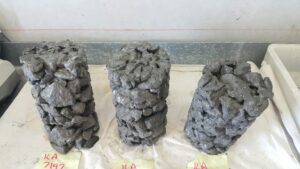
No-fines cylinders cast and ready for testing.
The nature of the materials was such that 100mm cylinders were cast. High Coefficients of Variance were obtained but within the expected range and the nominal 2MPa strength was met.
Table 1: A sample table of strength testing from the main mixes at Kaikoura Plant Operations
A uniquely challenging environment and the last word on collaboration
The operating environment provided unique experiences for our team to achieve the goals of our Client.
We cover a couple of them here:
- The Hapuku site was situated in the area where a dam had formed in the uplands due to a large landslip. We had to vacate the site once when a flood warning was issued as it was deemed the dam could burst its banks. Luckily it didn’t!
- Floods on the Hapuku that formed in short time due to the terrain of the area and short response time of the river to dumping of rain. This the teams scrambling to relocate equipment that through necessity were located within the wider floodplain.
- Drivers timing their runs to avoid waves going over the top of the freeboard on the seawalls.
- Teams frequently picking their way through boulders that came across the road and when they were big enough coordinating with the digger drivers to be able to get through the slip areas
- Drivers reversing up to 300m at night down slopes in all weathers using all their skill and experience
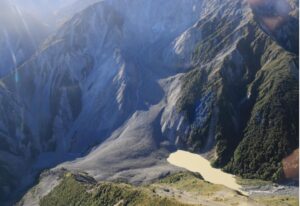
The dam formed in the upper Hapuku after the earthquake.
We are extremely grateful to have been given the opportunity to contribute to this project. It involved collaboration, communication and a partnering approach that we have not seen on any other project. This speaks largely for NCTIR Management, Supervisors of NCTIR, Allied Concrete Supervisors and its partners.
The story of concrete and Kaikoura is really a story about people. It is about the ability of Client and Supply teams to pull together quickly with a common purpose and work through very difficult conditions to deliver on commitments made. People often talk about once in a lifetime experiences and it is highly unlikely that the circumstances and operating environments experienced in Kaikoura will be replicated. The scale and objective complexity of the project will provide stories for those who participated in it for years to come.