
Request a Quote

Need a quote for your concrete product?

Request a Quote

Concrete Calculator

Use our online calculator to work out how much concrete you need!

Concrete Calculator

Tips & Tricks

A Guide to managing a pour

And getting the best results from your concrete

Click here to download a printable pdf version of this document for future reference

An awareness of the process and associated difficulties is required to effectively manage a concrete pour. Often the project manager is ultimately responsible to ensure all variables are covered.

Please contact ALLIED CONCRETE for more in-depth or detailed information. PH 0800 4 ALLIED

1: Setup & Ordering

  • Ensure safe & clear access to site for concrete trucks.
  • Reinforcing: is it required? – ask us about Allied Ready- Floor as an option.
  • Sub-grade preparation, level & flat – Is a vapour barrier such as polythene necessary?
  • Type of concrete, slump (workability ) and volume required. Check the weather, extra products may be required to cope with hot or cold conditions.
  • Speed of supply, how close together the concrete trucks are required – consider travel time, a retarder may be required to slow the setting time.
  • Have your account details or method of payment, contact phone number & site address available.
  • Concrete Cutting required? – if cutting is required ensure that it is done as soon as possible after placing.

2: Placing

  • Choose an experienced concrete placer, ask to view some of their recent work.
  • Monitor water added to concrete on site, (check with the batcher to ensure that the maximum water content is not exceeded).Adding extra water will reduce the concrete strength.
  • Vibrate or rod the concrete to ensure adequate compaction.
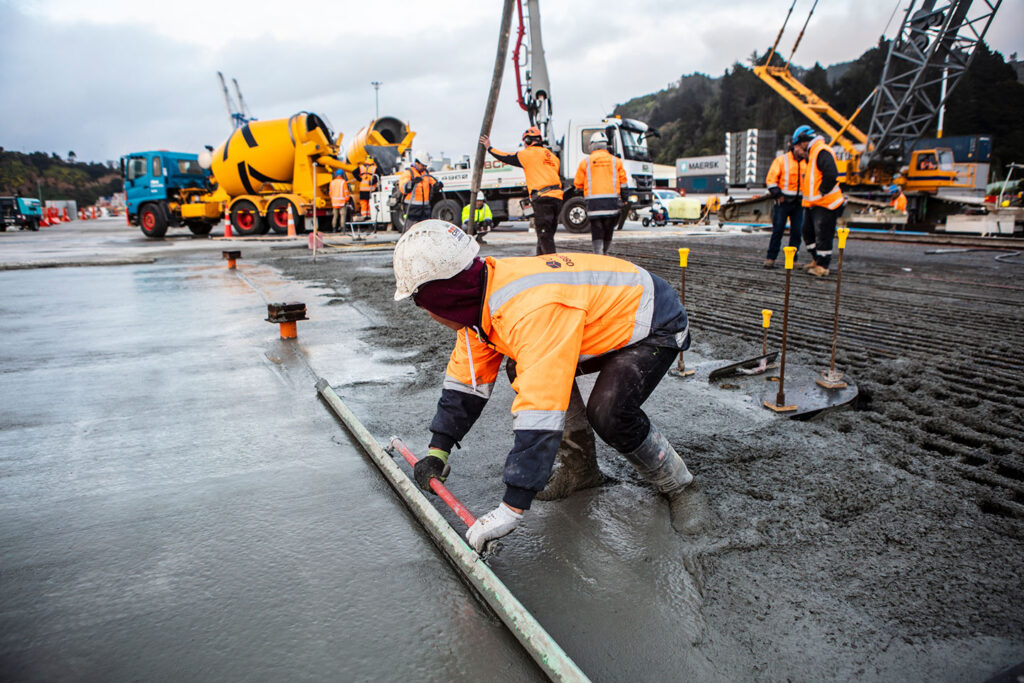
  • Screed the concrete to the correct level.
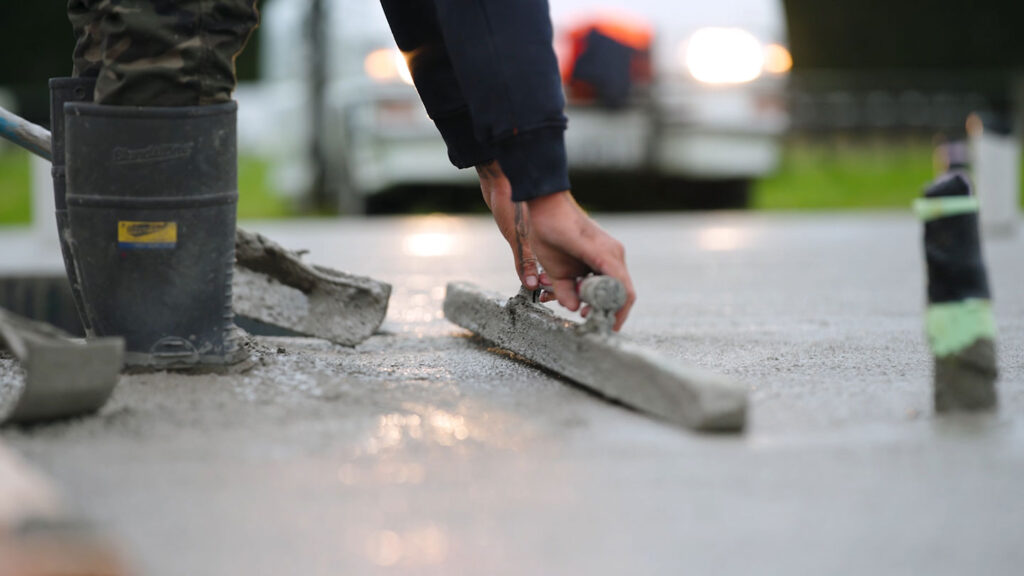
  • Float off to close the surface (smooth off).
  • Take care not to overwork wet concrete bringing too much cement paste to the surface and do not add water to the surface when troweling , either action will weaken the final surface.

3: Finishing

  • The finishing process can only begin when the concrete has stiffened sufficiently and the bleed water has evaporated from the surface. The timing of this will depend on the weather and concrete temperature.
  • The finishing process will determine how dense and hard wearing the concrete surface will be. Depending on the requirements different methods are available.
  • Mechanical power floating – for a hardwearing smooth surface, standard internal finish.
  • Bull Float – applicable for most external surfaces, can be broomed to add grip (will also increase surface area, not as hard wearing).
  • Decorative finishes, exposed aggregates, ground or polished. These are specialised finishes that require training and expertise to achieve a high level of finish.

4: Curing

  • Concrete should be protected from early loss of moisture; this loss can cause shrinkage cracking as little strength development has occurred to withstand the stresses resulting from the volume change (due to loss of water).
  • A good curing environment should exist immediately after finishing, and for best results for seven days.
  • After finishing and before curing can take place without damaging the surface, an evaporation retardant maybe required to slow moisture loss in hot weather.

Curing methods

  • Ponding – Build a sand bund around the perimeter and fill with water to cover slab
  • Spraying – The use of sprinklers to keep slab continuously wet.
  • Covering – Impermeable covering such as plastic sheet will trap moisture on concrete surface and minimise evaporation.
  • Curing Compounds – Apply after finishing when bleed water disappears. (Use with caution, these products may affect follow on trades like paint, tiles, vinyl, adhesives )

Minimise Cracking

Control Joints

A shrinkage control joint is defined in NZS3604 as “a line along which the horizontal strength of a slab is deliberately reduced so that any shrinkage in the slab will result in a crack forming along that line”.

  • All concrete cracks. Cutting or other methods try and control where.
  • Concrete should be cut as soon as possible without saw-cuts chipping on edges. ( within 12 hours in Summer, 24hours in Winter ) Soft-cut saws can be 6 to 8 hrs after placing.
  • Cuts should be 1/3 of the depth of the concrete, try and keep sections as square as possible to equalise shrinkage in each direction.
  • Control joints can also be made at the time of placing with a specially shaped trowel or by adding plastic or steel inserts.
  • Cracks may occur where dimensions change in the slab or around obstructions and re-entrant corners i.e. columns, waste pits, drainage sumps etc. Use diagonal bars at the corners or put in joints to prevents cracking. Make sure that any saw cuts are not too far apart to relieve stress.

Plastic shrinkage cracks

  • Plastic shrinkage cracks are formed in the surface of the concrete before it has set (or in a plastic state); often they may not become visible until some time later.
  • As a general rule : If it is good weather to hang out washing to dry it is ideal weather for plastic cracking to occur as well. Our web site www.alliedconcrete.co.nz has a graph to help you assess the risk of cracking on any given day.
  • Factors which lead to plastic cracking
  • Sunny and or windy days. (High evaporation rate )
  • Low humidity (Higher evaporation rate )
  • Exposed sites (Higher evaporation rate )
  • Broom finishes (Increase surface area and evaporation rate )

How to minimise the risk of plastic shrinkage cracking.

  • Do not place concrete when the weather conditions are too severe for you to control the evaporation rates of water from your concrete.
  • Moisten the sub-grade and forms prior to starting the pour.
  • Use polypropylene fibres in your mix – Allied concrete stock a wide range of poly fibre options.
  • Use an anti-evaporative spray to prevent excessive water loss from slab. We supply and recommend SIKA- film. (Use in accordance with manufacturers instructions)
  • Cover the concrete with polythene or membrane cure immediately after finishing.

Hot weather concreting

  • Assess the risk of plastic cracking ? Check weather conditions.
  • Organise workers & mixer trucks to avoid / minimise delays.
  • Use Antivap spray & cure the concrete.
  • Consider early morning or evening placement.
  • Retarder may be necessary to slow the setting time or to allow for travel.

Cold weather

  • Low temperatures drastically slow the setting process (less than 5 degrees is considered unfavourable)
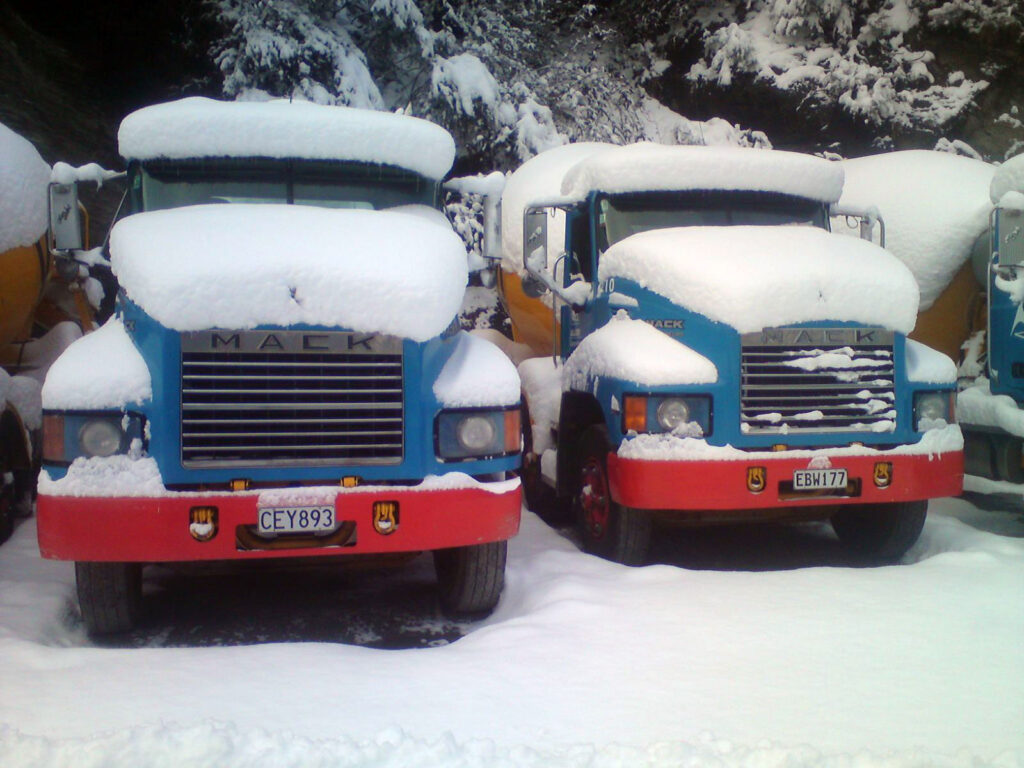
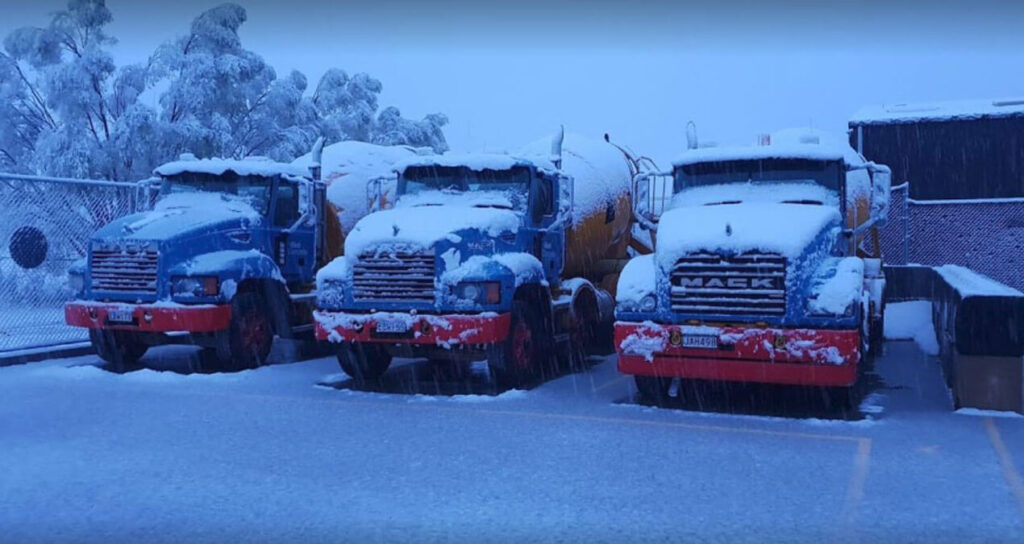
  • Do not place onto frozen ground or if snow is forecast • Order concrete with accelerator in it.
  • Consider using a higher grade of concrete & a lower slump (lower water content)
  • Do not attempt to finish concrete until all bleed water has evaporated, this will take longer on cold days.
  • If frost is expected cover the slab

Decorative Concrete

Decorative concretes cost a premium so it is important that proper care and planning are taken into account.

  • Not all colours are equal, Allied stock a premium range of integral colours that will not leach out of the concrete.
  • Recommended minimum strength for decorative concrete is 20MPa.
  • Areas in shade, time of day, and concrete poured in stages on different days can affect colour.
  • Accelerators will cause coloured concrete to produce a variable colour.
  • Coloured concrete often requires an acid wash to remove efflorescence (white minerals) from the surface. This is a specialised operation and requires experience.
  • Exposed or polished concrete will show any foot prints or marks that have been filled in by screeding slurry across them, should rather be filled with a shovel of mixed concrete.
  • Sealing concrete: don’t seal when concrete temp is below 12 degrees or when it is damp. ( Moisture will make the sealer go ‘milky” ) Minimum of 28 days from placing until concrete can be sealed.

Ask about our READY Solutions

WE MAKE WHAT’S HARD EASY

PH 0800 4 Allied

  • READYfloor – Steel fibre reinforced concrete is an economic alternative to traditional crack control mesh reinforcement and can be used for any lightly loaded concrete ground floor
  • READYcolour – For internal floors, driveways, patios, paths and pool surrounds think coloured concrete
  • READYexposed – Combine the strength, durability and affordability of concrete with the natural beauty of New Zealand’s spectacular riverbeds.

READY PRODUCTS

  • READYsealer, READYacid & READYthinner
  • Sika Rugasol® C - For exposed aggregate finish. Sika® Fibre - Reduction of plastic shrinkage cracks, reduced permeability and bleed water. SikaFilm® - Anti-evaporative spray, protects concrete from rapid moisture loss, helps reduce risk of plastic cracking. Sika® Accelerators - For faster setting
  • Sika® Retarders - To slow down the setting time. Sika® -1+ - To waterproof concrete.
   

Winter Concreting

Click here to download a printable pdf version of this document for future refere

Concrete can be successfully placed, finished and cured in winter so long as you understand what affect low temperatures have on the fresh and early age concrete.

The setting of concrete involves a series of complex chemical reactions that are very sensitive to temperature. This reaction, under normal conditions, gives off a considerable amount of heat. If it is so cold that the reaction slows down, the reaction and heat evolution is delayed - consequently, the strength gain will be drastically reduced.

The use of admixtures can over-ride some of the negative affects of low temperatures and enable you to continue to place concrete in low temperatures

So what is a "low" temperature?
In New Zealand, we are constrained in what we can and can’t do in the construction industry by the Building Code and the referenced documents that support the Code. The one we are interested in at the moment is NZS 3109. This Standard is quite specific in what are the permissible temperatures for concrete placement. This document is tied to the Building Code through NZS 3604, the key document for the house building industry in New Zealand. You are bound to satisfy the clauses in these documents, failure to do so could have significant consequences for you if things do not go to plan.

The clauses that refer to this are found in Section 7 of NZS 3109 (Concrete placing, curing and finishing.)

Specifically, Clause 7.2 .1 (Unfavourable Conditions) says that "concrete shall not be placed on frozen ground, nor shall concrete be placed in unfavourable conditions as defined in 7.2.2 which may be detrimental to the quality and finish of the concrete in the structure unless adequate precautions have been taken." NZS 3109 may be purchased from Standards New Zealand (visit www.standards.co.nz).

Unfavourable conditions?
The unfavourable conditions include temperatures below 5 degrees on a falling thermometer, or 2 degrees on a rising thermometer, or where it becomes impractical to work and finish the concrete adequately.

The precautions listed in the Standard include the use of air entrainers, using low slump concrete, using admixtures (accelerators and water reducers,) increasing cement contents, using some form of frost protection, and avoiding frozen ground.

Your responsibilities
You are all contractually responsible ultimately to the homeowner who is paying the bill. The lines of responsibility may vary though. For instance, if you are the placer, you are responsible to the builder who is in turn responsible to the owner. There is no shirking this line of accountability for the parties involved.

If you knowingly place concrete in the temperature conditions explained above, it is implicit that you have considered the risks and taken precautions to prevent damage to the slab. In the event of a problem later on, you may be held to account for your actions and asked to justify them in a court. There, the test of “reasonableness” will be applied (with the benefit of hindsight too).

It is risky to presume that a defence based upon the use of, say, air entrainment alone, will impress a judge when he is faced with an extensively spalled surface of a path, driveway or slab. Expert evidence will sink your argument very quickly.

If you are asked to place concrete in very cold weather, it would be prudent to get the instruction confirmed in writing. If you are the builder taking a risk, be prepared to face the financial consequences of deciding not to wait.

PRACTICAL SITE MEASURES

Planning

  1. Be organized.  Get the gear in place together with the labour, in time.
  2. Check the weather. A sunny afternoon will mean low overnight temperatures with the risk of a frost. If snow is forecast, get out your skis and put away the wheelbarrow!
  3. Consider using low slump (80mm) concrete. This concrete has a lower water content, it will bleed less and have a shorter setting time.
  4. Order concrete with accelerator in it.
  5. Consider using a higher grade of concrete. The extra cement will cause the concrete to set up faster.


On the job

  1. Do not place concrete on frozen ground. If snow is forecast cover the sub-base to protect it or delay the pour.
  2. Check the predicted temperatures for the day, and decide whether or not to proceed if temperatures are falling below 5 degrees, or if a frost is predicted overnight. If a decision is made to proceed get the covers necessary to protect the concrete from freezing.


Placement

  1. Place the concrete as early as practicable in the morning to give plenty of time to finish the surface in daylight.
  2. Do not wet up the concrete. Ensure the slump is not above 80 mm.
  3. Do not attempt to finish the concrete until all bleed water has evaporated. This can take some time on cold windless days.
  4. It may be necessary to remove the bleed water on cold windless days. Whatever system you use take great care not to mix the water into the top of the concrete. This will lead to a soft dusty surface.
  5. Do not spread cement onto the surface to dry up the top. This will lead to dusting and excessive crazing of the surface
  6. Do not overwork slabs that have had a delayed set due to low temperature. (Be careful that delayed finishing does not destroy the surface after final set has occurred).


Curing considerations

  1. If icy or frosty conditions are expected immediately after finishing operations have been completed, do not use water to cure the top surface as this will freeze and disrupt the top surface before it has had a chance to develop any strength.
  2. Cover the slab with straw and plastic to ensure the top of the slab remains above freezing point. Be aware that straw can discolour the top of the slab if it gets wet. If this is a concern consider using polystyrene or some other insulation mat instead.
  3. After the concrete has passed through its first night, remove the insulation and spray the concrete with a curing compound. If more severe weather is expected replace the insulation for at least the duration of the cold spell for good measure (or four days as a reasonable rule of thumb).
  4. Do not seal freshly placed concrete unless the sealer is specifically designed for application to new concrete at low or very low temperatures.
  5. If the concrete is warm after the use of the insulation, carefully remove the insulation in a way that will not drop the temperature of the concrete more than 20 degrees over a 24hour period. This will avoid the risk of thermal shock cracking developing.


Conclusions

Winter conditions place additional risks on the concrete placing industry. Forward planning and ordering the right concrete for the day can minimize these risks; BUT be prepared to call a job off until temperatures increase to above 5 degrees. The costs associated with this time delay are insignificant when compared to remedial work or full replacement costs later on.

Allied Concrete staff are more than happy to help you with any problems or enquiries.

For more information or assistance, please don't hesitate to call. Your call will be automatically connected to our nearest plant. (Calls from mobile phones will be directed for Auckland, Wellington or Christchurch.)

DISCLAIMER: Allied Concrete has endeavoured to present the best possible information. However we accept no responsibility for the application of the principles discussed.


Plastic Cracking

Click here to download a printable pdf version of this document for future reference

Plastic cracking occurs when the concrete you have just placed and finished is exposed to warm drying wind, and then develops cracking over the surface of the concrete.

The plastic shrinkage cracks will appear in the first few hours of the slab's life. These cracks are either irregular in shape and appear as tears in the concrete, or they are extremely regular in that they follow the outline of the mesh and other reinforcing.

Factors which can lead to plastic cracking:

  • Warm wind
  • Warm concrete
  • Low humidity
  • Low bleed concrete
  • Exposed sites
  • Broom finishes

How can I recognise the conditions likely to lead to plastic cracking?
As a general rule: If it is good weather to hang out washing to dry it is ideal weather for plastic cracking to occur as well. Use our Evaporation Calculator below to assess your risk of cracking on any given day.  Just enter the weather data, concrete temperatures and assess the risk accordingly.

When the concrete temperature is unknown, add 5 degrees to the air temperature if the sky is cloudy, or 10 degrees if it is a sunny day. These values are conservative and are likely to overstate the risk of plastic cracking.  For greater certainty we recommend that a digital thermometer be bought to give a more accurate assessment of the plastic cracking risk.

Evaporation Rate Calculator

oC

oC

km/hr

%

When the evaporation rate exceeds 0.5 Litres per square metre per hour, the risk of cracking is significant and precautions need to be taken to address this. See below:

How to minimise the risk of plastic shrinkage cracking?
Do not place concrete when the weather conditions are too severe for you to control the evaporation rates of water from your concrete. This means that in high winds and warm temperatures, the pour should be delayed unless you can protect the slab accordingly. Moisten the sub-grade and forms prior to starting the pour. Use polypropylene fibres in your mix. Use an anti-evaporative spray to prevent excessive water loss from the slabCover the concrete with polythene or membrane cure immediately after finishing.

Allied Concrete staff are more than happy to help you with any problems or enquiries.

For more information or assistance, please don't hesitate to call. Your call will be automatically connected to our nearest plant. (Calls from mobile phones will be directed for Auckland, Wellington or Christchurch.)

DISCLAIMER: Allied Concrete has endeavoured to present the best possible information. However we accept no responsibility for the application of the principles discussed.


Admixtures for Hot Weather

Click here to download a printable pdf version of this document for future reference

The summer time effects of wind, temperature, and air humidity can collectively have a detrimental impact on the performance of concrete. Higher temperatures cause a faster rate of water evaporation and cement hydration, thereby stiffening concrete earlier and increasing the risk of plastic cracking occurring.

Precautions

  • If possible, sprinkle cool water on forms, steel and subgrade before placing
  • Schedule mixer trucks to avoid waiting time
  • Organise the job in advance, quickly place the concrete, and have sufficient workers to avoid delays
  • After pouring, protect exposed surfaces from drying out through wind breaks, sunshades, fog sprays and approved curing membranes
  • After finishing, consider a curing membrane, plastic sheeting or water sprays and strength development
  • Use retarding admixtures to extend setting times
  • Consider early morning or evening placement

Admixtures for Hot Weather
The laying of concrete in hot weather places extra demands on the concrete worker. The ideal conditions for concrete curing are between 10-30 C. The addition of extra heat and/or wind can have a detrimental effect on the finished product because of rapid moisture loss. Concrete develops its properties of durability, wear resistance, permeability and strength over time. To develop these qualities, the hydration must be prolonged. Prolonged hydration requires adequate moisture as well as an even temperature range. The excessive loss of moisture can cause shrinkage cracking. These problems can be controlled through the use of Admixtures.

Retarders
These are designed to retard setting times so that the concrete worker has enough time to finish the surface of the concrete. It is also useful for maintaining concrete slump during long haul times to construction sites.   Retarders temporarily stop the chemical action of hydration but after the planned delay hardening develops at an accelerated rate.

Water Reducing Retarders
Water reducing admixtures improve important properties of concrete in both its plastic and hardened condition.  When wet the handling properties can be greatly improved without the addition of extra water.  In hardened concrete the properties of the concrete are improved because of the more effective dispersion and hydration of cement.  The retarding portion of the admixture delivers similar properties to the detail outlined above.  Sika BV40R and BV45R are examples of admixtures which provided both reducing and retarding properties.

Retarding Superplasticisers
Superplasticisers provide substantial improvements in workability and flowability without increased water, this allows for a lower need of vibration.  Ideal applications include slender components, columns and beams with congested reinforcement, situations where concrete discharge is difficult and applications requiring fast and efficient placement of concrete.  Sikament 1000R is an admixture which provides all these benefits as well as set retardation.

Allied Concrete staff are more than happy to help you with any problems or enquiries.

For more information or assistance, please don't hesitate to call. Your call will be automatically connected to our nearest plant. (Calls from mobile phones will be directed for Auckland, Wellington or Christchurch.)

DISCLAIMER: Allied Concrete has endeavoured to present the best possible information. However we accept no responsibility for the application of the principles discussed.


Hot Weather Concreting

Click here to download a printable pdf version of this document for future reference

The laying of concrete in hot weather places extra demands on the concrete worker.

  • Extra water required - For the same slump concrete requires more water when it is hot than when cold. This reduces strengths and increases drying shrinkage.
  • Sets quickly - Concrete setting is a chemical reaction. The hotter it is the faster it happens. However it can mean inadequate time to place and finish the concrete.
  • Increased risk of cracking - Loss of moisture increases the risk of plastic cracking and increased drying shrinkage.

Water Reducers and Superplasticisers
Water reducing admixtures improve the workability of a mix and improve the dispersion of the cement. They can be used to reduce the amount of water in a mix or to improve the workability for the same water content. Water reducers are in almost every metre of concrete produced. Superplasticisers are really just very efficient water reducers and give less set retardation. A reduction in water is very good for reducing shrinkage and improving strength.

Retarders
Retarders are designed to retard the set so that the concrete worker has enough time to finish the concrete. It is also useful for maintaining slumps during long hauls to a construction site. Retarders temporarily stop the hydration process but after the planned delay the hardening develops at an accelerated rate.

However if superplasticisers or increased amounts of water reducers are used to reduce water content then you will get less bleed than you will be accustomed to. Bleed is effective at protecting the slab from drying in the early stages, so for hot and/or windy conditions concrete.

Water reducers, superplasticisers and retarders retard the concrete setting. Plus, with water reducers and superplasticisers, you will have less bleed water. Again on hot and/or windy days this can mean the top dries out while the bottom of the concrete remains retarded. This leads to a "spongy" surface that is very difficult to recover.

The balance is to provide enough life to be able to work the concrete but have water misting equipment and anti evaporation sprays on hand to control evaporation. All loads should be dosed with the same amount of admixtures to ensure even setting times.

Allied Concrete staff are more than happy to help you with any problems or enquiries.

For more information or assistance, please don't hesitate to call. Your call will be automatically connected to our nearest plant. (Calls from mobile phones will be directed for Auckland, Wellington or Christchurch.)

DISCLAIMER: Allied Concrete has endeavoured to present the best possible information. However we accept no responsibility for the application of the principles discussed.


Concrete Crack Control

Click here to download a printable pdf version of this document for future reference

Because ready mixed concrete is delivered in a fluid state then subsequently becomes a solid, the chemical and environmental influences on the change may sometimes causes cracking. It is very unusual that these cracks cause any loss of strength but they provide a negative prospective to the end users of the product.

The placing and the curing of the concrete has the single biggest influence on the quality of the end product.

The following table outlines the important information regarding the cause, and control of cracking in Allied Ready Mixed Concrete.

Crack Type

Plastic

Thermal

Drying

When Seen

Same Day.

First Few Days.

Weeks, months later.

Where they Appear

Random, no pattern and short in length.

Along the weak dimension of the slab i.e. box outs, gully traps.

As for thermal cracking.

Cause

Rapid evaporation of water from the slab surface.

The chemical reaction of cement hydration causes heat in the slab. The difference in temperature between the slab and the atmospheric temperature causes different expansion/ contraction rates, therefore cracking.

Long term drying of concrete causes shrinkage, any restraint to the slab shrinking causes cracking.

Prevention

Lower the evaporation from the slab.
(See Concrete Curing Tip)

Reduce the restraints to slab movement/ contraction e.g. lower bay widths and pour dimension.

Correct location of saw cuts and construction joints.
Properly positioned and use of free movement joints.

Once Cracked
(Assess what the crack will do)

Leave as they are, better not to fill.

Will act as a saw cut, leave till the end of the project.
Joints can then be filled, edges protected.

As for thermal cracking.


Allied Concrete staff are more than happy to help you with any problems or enquiries.

For more information or assistance, please don't hesitate to call. Your call will be automatically connected to our nearest plant. (Calls from mobile phones will be directed for Auckland, Wellington or Christchurch.)

DISCLAIMER: Allied Concrete has endeavoured to present the best possible information. However we accept no responsibility for the application of the principles discussed.


Setting Time of Concrete

Click here to download a printable pdf version of this document for future reference

The practical use of concrete as a construction material depends upon the fact that it is ”plastic” in the freshly mixed state and subsequently becomes hard, with considerable strength. This change in its physical properties is due to the chemical reaction between cement and water, a process known as hydration. Hydration involves chemical changes, not just a drying out of the material. Hydration is irreversible. The reaction is gradual, first causing stiffening of the concrete, and then development of strength, which continues for a very long time. Under certain ideal conditions it is probable that concrete would continue to increase in strength indefinitely.

Air temperature, ground temperature and weather conditions all play major roles in the rate with which cement hydrates. The setting time of concrete decreases with a rise in temperature, but above 30oC a reverse effect could be observed. At low temperatures setting time is retarded. Proper curing techniques and site preparation will aid the setting time. However when concrete is being used in times of temperature extremes, i.e. colder weather or in the middle of summer, several admixtures may be used in the concrete mix to aid in the placement of the final product. These admixtures are Accelerators and Retarders.

Accelerators have been designed to significantly boost the early setting times and increase the early age strengths of concrete. Setting times of non accelerated concrete are significantly slower as temperatures get colder. This obviously affects finishing times. The action of the accelerator counters this set retardation and shortens setting times back to what is considered a normal set time.

Retarders are designed for use in areas where early setting of concrete is not preferable, e.g. high ambient temperatures, long travel times between concrete plant and job site, large slow pours - to prevent formation of cold joints etc. The chemical composition of the retarder is formulated to temporarily stop the action of hydration, delaying the initial set of the concrete. This delay is proportional to the dose of retarder used. Once the effect of the retarder wears off initial set will take place and hardening will develop at an accelerated rate.

The two graphs below demonstrate the effects of accelerators and retarders on the setting time of concrete.

Effect of Accelerators on Concrete Setting Time


Effect of Retarders on Concrete Setting Time

setting-time-concrete-g2

Allied Concrete staff are more than happy to help you with any problems or enquiries.

For more information or assistance, please don't hesitate to call. Your call will be automatically connected to our nearest plant. (Calls from mobile phones will be directed for Auckland, Wellington or Christchurch.)

DISCLAIMER: Allied Concrete has endeavoured to present the best possible information. However we accept no responsibility for the application of the principles discussed.


Concrete Curing

Concrete develops its properties of durability, wear resistance, permeability and strength over time, rapidly at first but then more slowly. To develop these qualities, the prolonged hydration of cement must be encouraged. Hydration requires the presence of moisture and a favourable temperature.

Read more: Concrete Curing


Cold Weather Concreting

The expansion of water as it freezes can cause serious damage to partly set concrete. In cold conditions cement hydration slows and concrete takes longer to gain strength. In most parts of New Zealand the critical period is the first 24 hours, in particular, the first night. Concrete should not be placed on frozen ground. Placing concrete into shady areas and/or where there is little air movement below temperatures of 10 degrees Centigrade will contribute to slower cement hydration.

Read more: Cold Weather Concreting


Admixtures For Cold Weather

Click here to download a printable pdf version of this document for future reference

Cold weather provides new challenges to the concrete worker. Cold weather can increase concrete set times, retard concrete stiffening and slow its strength gain. It is also interesting to note that cold weather concrete has superior properties to concrete placed in hot weather. If the concrete doesn't freeze and is cured properly, it reaches a higher ultimate strength, is more durable, and less susceptible to thermal cracking. Concrete in the plastic state freezes when the mix temperature is less than -2 degrees Centigrade and the concrete is left undistributed long enough for ice crystals to form. Once ice has formed, hydration stops and strength development is seriously impaired. Fresh concrete frozen during the first 24 hours can lose 50% of its potential 28 day strength. A number of these problems can be overcome through the addition of admixtures to concrete.

Accelerators
Accelerating admixtures can help offset the effects of low temperatures by increasing the rate of cement hydration. This aids in the concrete setting time and the development of early strength in the concrete.

Dose rates of accelerator vary depending on the ambient temperature at the job site.

Air Entraining Agents
Entrained air greatly improves concrete freeze/thaw resistance to damage. The addition of an air entraining agent causes millions of extremely small air bubbles to be introduced into the concrete matrix. This 'entrained' air remains in the concrete where the larger, naturally 'entrapped ' air will make its way to the concrete surface during normal placing operations. Because ice occupies a much larger volume than its original liquid, it exerts great pressures within the concrete which can damage the cement paste. Repeated cycles of freezing and thawing will eventually lead to a deterioration by providing extra space for the pressure to be dispersed over. Air entrainment also leads to increased workability and general durability of the concrete.

Superplasticsers
Superplasticsers are high range water reducers. These can lead to a 10% - 30% reduction in the water content of a given concrete mix, but with workability characteristics of a normal slump mix  still retained. This is an important factor in cold weather because if the water/cement ratio of a concrete mix is reduced the resultant concrete will have enhanced durability and strength characteristics. Superplasticsers are generally used when a low slump concrete is specified but good easy-to-place concrete is still required. The effects of superplasticser are limited to about 45 minutes from the time of mixing so care must be taken when scheduling loads.

HE200 Early Age Strength Admixture
Sikament HE200 is a new technology admixture that provides an effective superplasticising action on fresh concrete and rapidly accelerates its early age strength development without any negative effect on the final strength. HE200 is ideal in colder temperatures where accelerated strength development is necessary.

Allied Concrete staff are more than happy to help you with any problems or enquiries.

For more information or assistance, please don't hesitate to call. Your call will be automatically connected to our nearest plant. (Calls from mobile phones will be directed for Auckland, Wellington or Christchurch.)

DISCLAIMER: Allied Concrete has endeavoured to present the best possible information. However we accept no responsibility for the application of the principles discussed.